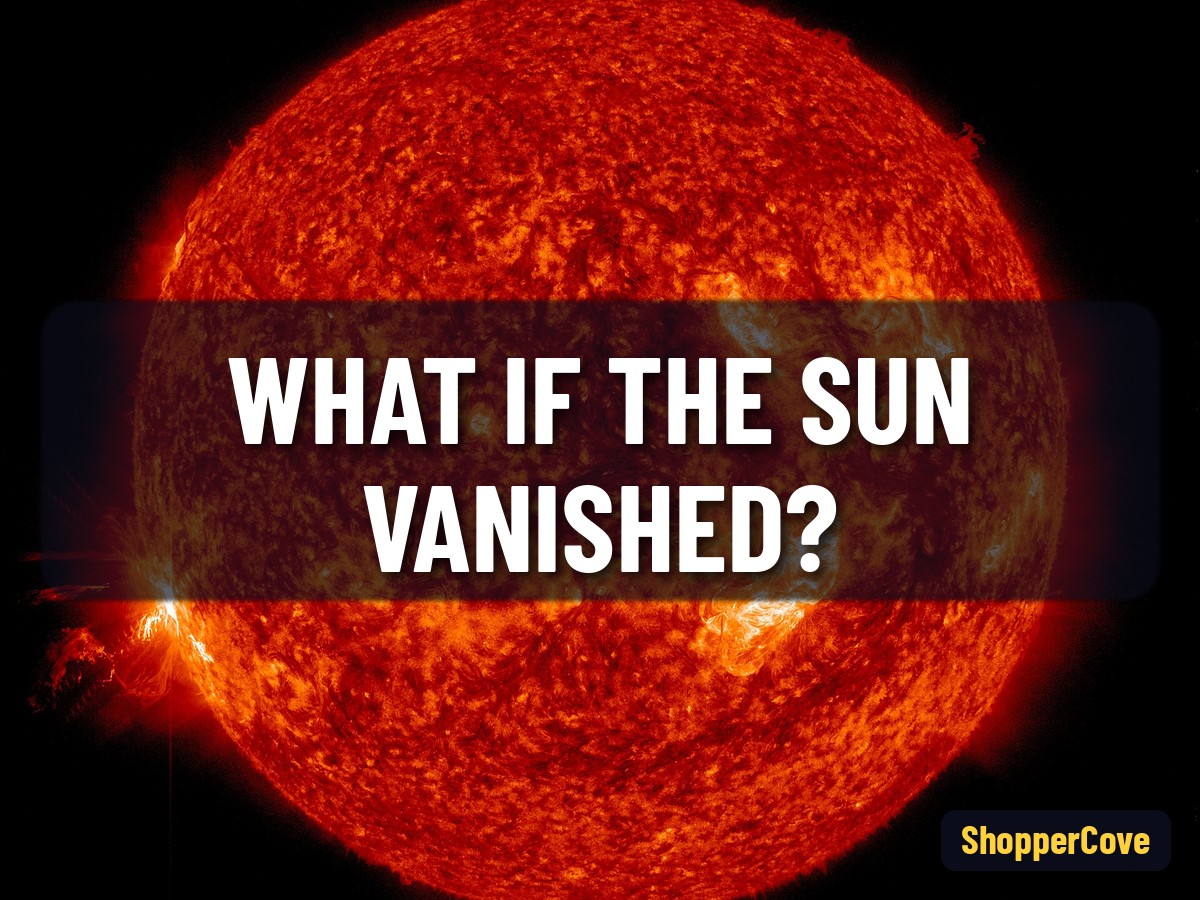
What If the Sun Disappeared? The First 8 Minutes
A physics thought experiment: light, gravity, and a planet suddenly without a star.
3 min read
Summary
What if the Sun disappeared? For about 8 minutes and 20 seconds, nothing would change on Earth, because sunlight and changes in gravity both travel at the speed of light. Then the sky would go dark, the Moon would vanish from view, and Earth would leave its orbit and coast in a straight line.
This is a thought experiment. The Sun cannot simply vanish; physics does not allow mass and energy to disappear.
Why would it take 8 minutes to notice?
Light from the Sun takes about 8 minutes 20 seconds to reach Earth. General relativity says changes in gravity also travel at light speed, so the last sunlight and the loss of the Sun's pull would arrive together. In 2017, gravitational waves and light from the neutron-star merger GW170817 reached Earth within about two seconds of each other after travelling roughly 130 million years, which supports that idea.
What would happen to Earth's orbit?
With no Sun to curve its path, Earth would keep moving at about 30 kilometres per second in a straight line, tangent to its old orbit. There would be no sudden jolt. The Moon would stay bound to Earth and travel with it, and the other planets would also fly off in their own directions.
How cold would Earth get?
Earth would cool steadily, because no new sunlight would arrive. The atmosphere and oceans store heat, so cooling would take days to months rather than minutes, and heat from Earth's interior would keep some deep ocean water liquid far longer than the surface. Exact temperatures are estimates that depend on the model used.
Could anything survive?
Plants would stop photosynthesising almost at once. Life that relies on chemical energy, such as microbes around deep-sea hydrothermal vents, is the most often cited candidate to last much longer.
FAQ
Would we see the Sun disappear instantly? No. We would keep seeing it for about 8 minutes 20 seconds.
Would Earth crash into another planet? It is very unlikely. Space is mostly empty, and Earth would move off on its own path.
Would the stars still shine? Yes. Other stars are unaffected, and they would be easier to see in a permanently dark sky.
Related
Sources
- 01astronomy.com/science/if-the-sun-suddenly-disappeared-it-would-take-about-eight-minutes-for-earth-to-become-dark-due-to-the-speed-of-light-how-long-would-it-take-to-feel-the-absence-of-the-suns-gravity/
- 02public.nrao.edu/ask/what-would-happen-to-earth-if-the-sun-suddenly-disappeared/
- 03van.physics.illinois.edu/ask/listing/16045
- 04ligo.caltech.edu/page/press-release-gw170817
Lab evidence
What I found running this
Facts in this draft were checked on 14 Oct 2026 against the sources listed in the body (official records, publishers, encyclopaedias, research papers and named news outlets). No original testing or reporting was done; figures are quoted as published by those sources, fiction and folklore are labelled as such, and any estimate or prediction is labelled as such.
Explore the product
Creators and marketers who want cartoon-style explainer videos
Animate science thought experiments for YouTube
Animate a space what-if with VidToonTurn space what-if questions into doodle explainers
Make a what-if science doodle with InstaDoodleKeep reading
Python partition vs split: Which One Should You Use?
Both cut a string at a separator, but they fail in different ways. We ran them on Python 3.13.5 to show where partition() is safer and where split() is the right tool.
Summary2 Nov 20263 min read
toSorted vs sort JavaScript: Which One Copies Your Array?
What changes when you swap sort() for toSorted(), with a real 1-million-item Node.js benchmark and the support table.
Summary1 Nov 20263 min read
How to Reorder a YouTube Playlist, and Why Won't It Drag?
Dragging videos is the official way to change a playlist's order. Here are the steps from YouTube Help, where to find them in YouTube Studio, and the cases where reordering will not work.
Summary31 Oct 20263 min read