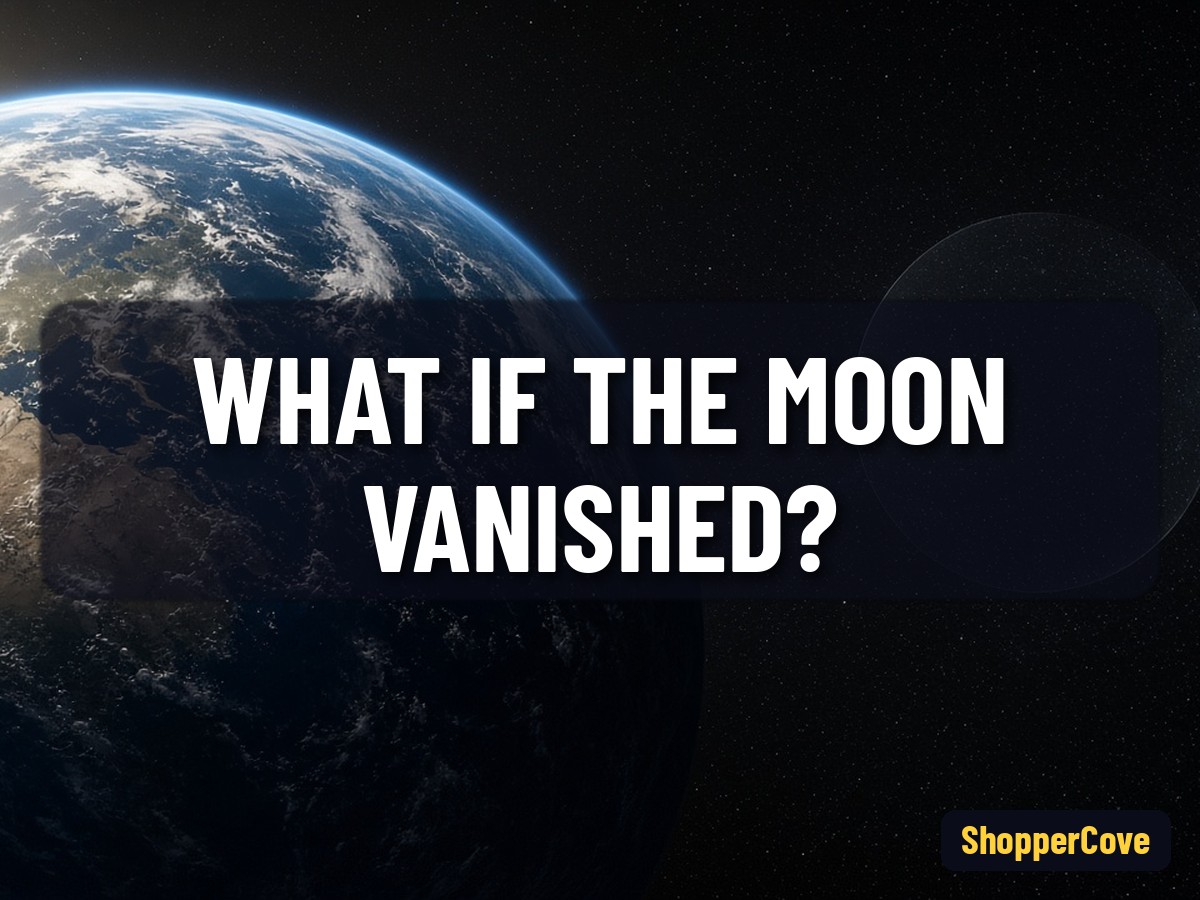
What Would Happen If the Moon Disappeared Tomorrow?
A science what-if built on NASA facts, from tides to Earth's tilt.
2 min read
Summary
If the Moon disappeared, tides would shrink to about a third of their current size, nights would get much darker, and over very long periods Earth's tilt could wobble more, making climates less stable. This is a thought experiment, since nothing could remove the Moon overnight, but each effect is based on how the Moon shapes Earth today.
What would happen to the tides without the Moon?
The Moon drives most of Earth's tides. The Sun also raises tides, at a bit under half the Moon's strength. Without the Moon, only the smaller solar tides would remain, which would change coastal ecosystems that depend on tidal zones.
Would Earth's tilt change without the Moon?
NASA says the Moon's pull stabilises Earth's wobble on its axis, which keeps the climate relatively steady. Earth's axial tilt is about 23.4°. Modelling studies suggest that without the Moon the tilt could swing much more widely over millions of years. The amount is debated: some research finds smaller swings than early estimates did.
How dark would nights be without the Moon?
Every night would be as dark as a new-Moon night. Many animals use moonlight for hunting, navigation or timing reproduction. Some corals, for example, time their spawning to the lunar cycle.
Would days get shorter?
Tidal friction from the Moon slows Earth's spin, and NASA notes the Moon drifts about 3.8 cm farther away each year. Without it, that slowing would mostly stop, though the change in day length would be tiny on a human timescale.
FAQ
Could the Moon actually disappear? No known process could remove it suddenly.
Would we die without the Moon? Not immediately. The effects would build over long timescales.
Is the Moon moving away? Yes, by about 3.8 cm per year, measured with lasers bounced off reflectors left by the Apollo missions.
Related
Sources
Lab evidence
What I found running this
Facts in this draft were checked on 13 Oct 2026 against the sources listed in the body (official records, publishers, encyclopaedias and named news outlets). No original testing or reporting was done; figures are quoted as published by those sources, fiction and folklore are labelled as such, and any estimate or prediction is labelled as such.
Explore the product
Teachers, marketers and creators who want whiteboard-style videos
Turn science what-if questions into doodle videos
Make a what-if doodle video with InstaDoodleStart an animated what-if YouTube channel
Animate your first what-if episode with VidToonKeep reading
Python partition vs split: Which One Should You Use?
Both cut a string at a separator, but they fail in different ways. We ran them on Python 3.13.5 to show where partition() is safer and where split() is the right tool.
Summary2 Nov 20263 min read
toSorted vs sort JavaScript: Which One Copies Your Array?
What changes when you swap sort() for toSorted(), with a real 1-million-item Node.js benchmark and the support table.
Summary1 Nov 20263 min read
How to Reorder a YouTube Playlist, and Why Won't It Drag?
Dragging videos is the official way to change a playlist's order. Here are the steps from YouTube Help, where to find them in YouTube Studio, and the cases where reordering will not work.
Summary31 Oct 20263 min read